Personality Types
DRIVER . EXPRESSIVE . ANALYTICAL . FACILITATOR . ORGANIZER . AMIABLE
Introduction
Personality Styles studied here are based on the Personal Styles defined by David W. Merrill and Roger H. Reid in their work “Personal Styles & Effective Performance.” This work defines four Personality Types as; Analytical, Amiable, Driver, Expressive; (which bear some similarity to the PTypes and some other models of Interpersonal Styles).
Introduced here are two new Personal Styles defined as; Facilitator and Organizer. This is done on the belief that these will complete the model by taking from four types to a necessary six types. This belief is built from the archetypes of behavior are based on dynamic elements of; Physical, Emotional and Intellectual energies, and their cominations of; Physo-Emotional, Physo-Intellectual, and Emot-Intellectual Energies energies manifest in six types of behavior. These energies that are common to us all are just used differently based on our preferences and tendencies. These underlying patterns within us may recapitulate dynamic patterns that are found throughout nature and reflected in the change seasons and the patterns of stars. The better we understand the transcending elements, the better we can construct out models of behavior.

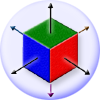
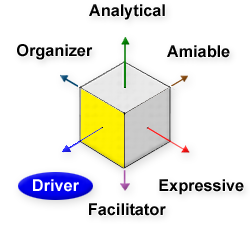
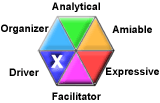
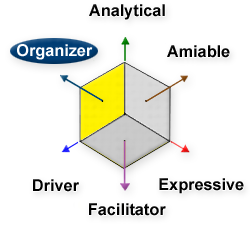
The Hex Model (left), developed by K. David Katzmire, is an expansion of existing four-styles models to introduce two Interpersonal styles, the Facilitator and the Organizer. Designed to fill what this author perceives as missing parts of the puzzle, it completes the identification of Physical, Emotional and Intellectual energy patterns, and their combinations to define six discernable styles of behavior. This is not to suggest that the existing four-style models are anything less than excellent and useful, it is only intended as an enhancement. Consequently, The Hex Model is more complex, but it is more telling. The six-style Hex model indentifies Styles, old and new, as:
Driver Expressive Analytical Facilitator Organizer & Amiable
Personal Styles Square Model
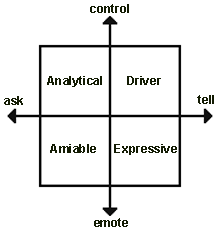
An Earlier Model (right), was created by David W. Merrill and Roger H. Reid who identified the four basic Interpersonal Styles of behavior as:
This basic four-style model is widely followed and used as a basis for consulting businesses, and it is what makes the suggestion of the Hex model possible. Other studies that support four-style model include The Four Ego Functions as described by Carl Jung, and the Myers-Briggs Personality Tests that devrived from it, (these and other relative models can be found in Chapter 4. Related Works).

Control
Options
Clarity
Focus
Personality Types – Driver Style
Evidence
Action
Winning
Expediency
Know what they want. Forceful. Act quickly. Ask for (or create options). Balance cost & quality. Explain needs clearly.
Careful listening. Action. Result-oriented info.. Efficiency. Options. Quick, concrete response. No defensiveness. Sparring

Trust
Openess
Big Picture
Inspiration

Teamwork
Relationships
Innovation
Fluidic
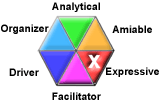
Adaptability. Sociability. Innovation. Quality Concern. Collaboration. Open information
Adaptability. Sociability. Innovation. Quality Concern. Collaboration. Open information
The “Big Picture” with discussion. Open, Trusting Relationships. Help winning internal support for proposal. Discussion with good listening & questions. Room for their input on proposals. Collaboration, Teamwork

Process
Precision
Evidence
Criteria
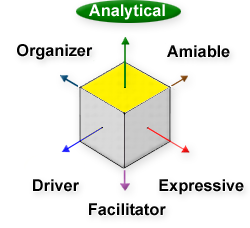
Efficiency
Information
Organization
Logic
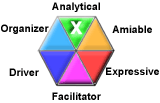
Dependability. Thoroughness. Personal distance. Informed, Practical, Decisive. Linear, sequential thinking.
Logic & Data. Structured approach. Factual evidence. Professionalism. Details. Practicality.
Under stress this style may tend to:. Avoid

Balanced
Social
Holistic
Methodical

Multifaceted
Practical
Centered
Attentive
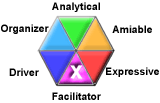
Responsibility. Coordination. Loyalty. Innovation. Meeting Objective. Working with Others.
Plan of action. Systematic approach. Benefit to others. Cost effectiveness. Conservation of resources. Quick response.

Orderly
Pensive
Rational
Conservative
Theoretical
Abstract
Foresight
Planning
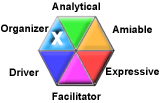
Design. Organization. Detail. Research. Objectivity. Determination.
Abstract Ideas. Specialized approach. Categorized thought. Historical support. Potential benefits. Meeting demands.

Acceptability
Trust
Support
Cooperation

Commitment
Relationships
Reputation
Interest
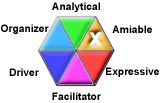
Emo–Intellectual styles tend to be Interactives, personable and cooperative, while being informed and up to date. They are sociable with trusted personal relationships and regard for consensus opinion. The Amiable style of person appears to be warm, cooperative, and genuine. Emphasizing the ?personal touch,? this style takes time to establish trusting personal relationships with business associates and tends to work closely with others to obtain and process information, as well as discover solutions. Responding to the recommendations of authorities and trusted acquaintances, Amiable feel that reputation and acceptability are highly important, which causes them to seek consensus and support in decision-making.
Sensitive to other” needs. Loyal trusting relationships. Ensure claims are honored. Develop consensus. Ensure acceptability of solutions.
Cooperation. Careful listening. Support of personal goals. Third-party references. Guarantees. Shared decision making.
Examples of Personality Types in Action . . .
Once personality archetypes are known, you can recognize them in practice. Here are some examples of how the six differents styles might assume roles as team players in different situations:
| Business Office | ||
| Dept. Head | DRIVER | Puts the crew in motion |
| Accounts Rep. | EXPRESSIVE | Uses personality to sell |
| Accountant | ANALYTICAL | Crunches the numbers |
| Project Mgr. | FACILITATOR | Implements the plan |
| File Clerk | ORGANIZER | Sets the plan |
| Recept./Sec. | AMIABLE | Greets all and works with them |
| Theater Production | ||
| Producer | DRIVER | Makes show possible |
| Actor | EXPRESSIVE | By definition |
| Reviewer | ANALYTICAL | Gives critique |
| Director | FACILITATOR | Coordinates the players |
| Set Designer | ORGANIZER | Sets the stage |
| Pub. Agent | AMIABLE | Works with all Styles |
Here is a look a deeper look at some Personality Type characteristics:
| Element | DRIVER Physical |
EXPRESS. Emotional |
ANALYT. Intell. |
FACILIT. Physo–Emo. |
ORGANIZ. Physo–Int. |
AMIABLE Emo–Int. |
| Basic Need | To Win | To Be Adored | To Be Right | To Help | To Arrange | To Avoid Pain |
| Use of Time | Present | Future | Historical | Past to Present | Past to Future | Present to Future |
| Decision Making | Quick, Goal Oriented | Fast, Intuitive | Unhurried, Thoughtful | Swift, Interactive | Deliberating, Objective | Slow, People oriented |
| Questions | What | Who | How | When | Where | Why |
| Specialty | Control | Social | Systematic | Logistic | Structure | Support |
| Strength | Decisive | Enthusiastic | Thorough | Active | Foresight | Listening |
| Weakness | Insensitive to Others | Impulsive | Poor Improviser | Pinpointing Problems | Hands on experience | Taking a stand |
| Back-up Style | Autocratic | Attacker | Avoider | Contradiction | Rigidity | Acquiesce |
| Wants | Control | Recognition | Respect | Motion | Order | Approval |
| Let Them Save | Time | Effort | Face | Influence | Resources | Relationships |
| Make Effort to Be | Efficient | Interesting | Accurate | Holistic | Theoretical | Cooperative |
| Emphasize Your | Options & Probabilities | Testimonies & Incentives | Evidence & Service | Openess & Adaptabilities | Examples & Blue Prints | Assurance & Guarantees |
| Follow up With | Results | Attention | Service | Updates | Review | Support |
| Orientation | Results & Closure | Concepts & Ideas | Principle & Thinking | Balance & Integration | Abstract & Ideals | Teamwork & Harmony |
| To Motivate | Set the Goals | Move the Spotlight | Change the Policy | Find a Method | Use a Model | Take a Vote |